
Interview Christiane Bosman
Confluence of European Water Bodies 2025
Try to imagine what it feels, smells, sounds and looks like when two or more rivers flowing through a landscape meet, combine and continue onwards as a single body, until they come across a new water body and the process repeats itself. A term widely used in English to describe this coming together, combination and concurrent flowing of water bodies is confluencing. But it is not only rivers, streams and lagoons that confluence. The same thing happens in a meeting between human water bodies: people and objects also confluence when they get to know each other and exchange ideas and information.
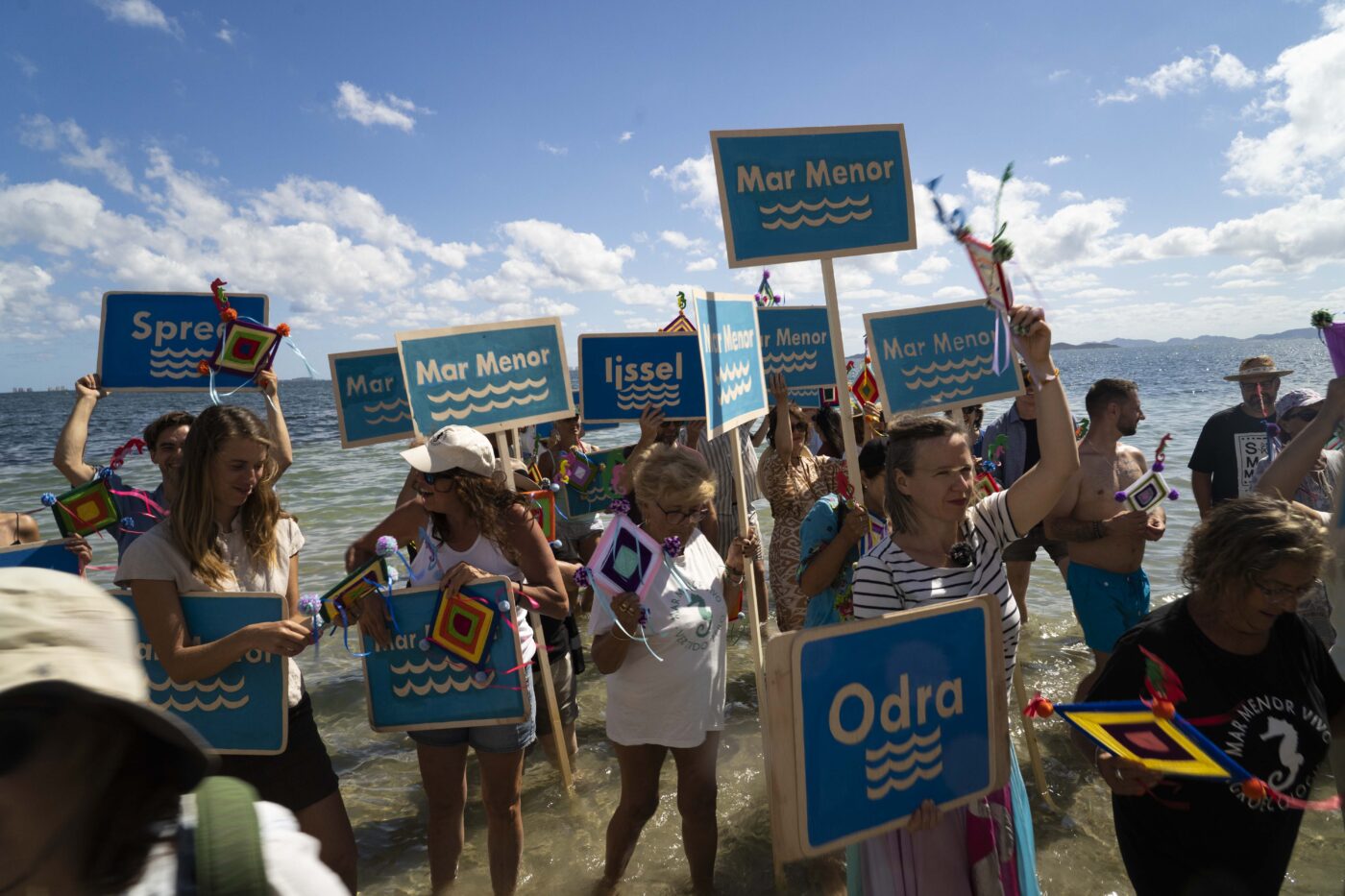
Both human and non-human confluencing are soon due to coincide during the Confluence of European Water Bodies, an annual three-day meeting that brings together the representatives of water bodies from all corners of Europe. The aim of the Confluence, established in 2023 by the Embassy of the North Sea, ILP Mar Menor and the TBA-21 Academy, is to encourage new dialogue and to establish new relationships with water. After all, despite the fundamental importance of water for all life on Earth, the voice of water is barely heard during political decision-making processes. And, in the words of Christiane Bosman, who together with the TBA21 Academy in Venice is responsible for the European network of water bodies at the Embassy of the North Sea, that needs to change. “Many of the waters in Europe, and as a consequence the people of Europe, are severely ill. Only when we once again recognise water ecosystems as being integral to ourselves will we take true responsibility for the wellbeing of those water bodies.”
Bosman, trained as a specialist in art and heritage, has always shown an interest in listening to unheard voices – be they the human voices of marginalised groups in society or the voices of forests, mountains, water bodies and all the life forms they contain. Her graduation thesis discussed how artists can encourage the consideration of decolonial ideas in history museums. Even during this period of her life, Bosman was always interested in the natural world. However, it was not until she came into contact with the artwork Forest Law (2014) produced by artist Ursula Biemann and architect Paulo Tavares that her focus truly shifted to ecological issues.
Interactions and networks
The film Forest Law is about the Amazon rainforest in Ecuador, the first place on Earth where the rights of nature were truly integrated in a nation’s constitution. But why did the idea appeal to her so strongly? Bosman explained, “If you ask me, unheard voices are by definition the most interesting. Not only because for those who do listen to them they open new doors into new worlds, but above all because they help us understand that the way we normally listen follows a predetermined hierarchy, according to a predetermined world view. After watching this film, I realised that the source of those voices need not necessarily be human, and that non-human voices also have a great deal to tell us.”
As Bosman went on to explain, once you have recognised this fact, your view of yourself and of your environment undergoes a radical shift. “Religious scholar Kocku von Stuckrad describes it as the relational turn; a shift in perspective in science and art that eradicates the dichotomy between nature-culture, human-non-human, spirit-matter and subject-object. You suddenly realise that the world does not have a single centre but is in fact made up of interactions and networks. Thinking in terms of networks and interactions casts a new light on a whole variety of systems of thinking elaborated by humans in the past, such as colonialism, capitalism, the Enlightenment and religion. At the same time, it is a gateway to a radical shift in the way in which we approach the future.”
Bosman looks at art in the same light. She has no real interest in a view of art in which a central power base determines what makes ‘good’ art worthy of a support grant or good enough to be displayed in a museum. In Bosman’s own words “Instead, I seek inspiration often in non-Western cultures, where the creation of art is considered an ever recurring communal effort, that must constantly be created and celebrated together. In that sense, I also view the Confluence of European Water Bodies as a work of art, formed in a fluid process of creation by numerous contributors: anthropologist and lawyer Carolijn Terwindt, curator and artist Leon Lapa Pareira, Pietro Consolandi of the TBA21 Academy, my close colleagues Thijs Middeldorp and Harpo ’t Hart, and of course the more than 100 creators and thinkers in our network.”
The presence of water
Bosman first came into contact with Middeldorp, one of the founders of the Embassy of the North Sea, around 7 years ago. Based on the conviction that the North Sea belongs only to itself, since 2018, the Embassy has gradually been working to improve representation of the North Sea in politics, law and culture. Today, Bosman is responsible for the content of several research and public outreach programmes undertaken by the Embassy, including the Confluence of European Water Bodies.
The first edition of the Confluence was held at the Mar Menor in Murcia, a small inland sea in Southeastern Spain, which was the first European water body to acquire the status of an individual legal personality. Last year, representatives of all the affiliated water bodies, of which there now no less than thirty-five, held a Confluence at the Venetian Lagoon. In September, their representatives are set to travel to Amsterdam and Bergen aan Zee, where they will follow a three-day interdisciplinary programme of lectures, workshops, art projects, films and musical performances.
All water is connected and constantly on the move. But how do we as the human representatives of water come together? The answer is in the form of rituals such as the annual pilgrimage to a different body of water in Europe each year. The first Confluence, which started with the presentation of a collective manifesto to the European Parliament, took the form of a train journey by the representatives from Brussels to the Mar Menor.
This event was quite literally attended by all the represented water bodies. But how? “Each representative had provided a phial of water from their water body,” explained Bosman. “Together with other objects, films and documents, images, data and stories about the various water bodies, the phials were placed in a case that was given the name the Diplomatic Suitcase. For the past two years, this suitcase has journeyed around Europe and has been unpacked and installed in galleries, museums and embassies. The Diplomatic Suitcase is an appealing object that allows the local water stories to be told in any number of new locations, with the aim of encouraging the public to think about which the of water to which they feel most closely related.”
Bosman went on to explain that the network today is far more than just the annual Confluence. Water bodies are actively reaching out to one another for research, joint publications, projects and conferences. They also come together during major United Nations water conferences such as the UNOC held in Nice last June, where a series of joint actions were initiated.
Methods of representation
For Bosman, this further illuminates the bilaterial character of the Confluence. On the one hand, the representatives of the water bodies come together to underpin the combined nature of the goal, namely to improve the political, legal and cultural representation of water ecosystems on an overarching European level, while on the other hand, the network of the Confluence actively focuses on investigating the specifically local character of individual relationships between people and water as it ties in with individual locations and cultures. “One example of the questions investigated is: how is it possible that Spain has succeeded in granting the Mar Menor the status of legal personality? What does that fact say about the relationships between the individual people and between those people and water? Which words do they use; what rituals do they adhere to; and what does the water in that location say about human identity?”
All bodies of water affiliated to the Confluence have their own unique methods of representation. The aim of all those methods, including the granting of the status of political (legal) personality, is to bring about a shift in our world view such that we begin to recognise bodies of water as living entities, with their own voice. For the river Spree in Berlin, for example, the specially founded artistic research collective SpreeBerlin has developed a unique buoy. This device measures the water quality of the river, and communicates the measured data with the public, in real time. In Poland, through their programmes and actions focused on the Vistula river, the Polish River Sisters have among others successfully prevented the construction of the Siarzewo Dam.
Another example is the political campaign in Iceland, Snæfellsjökul fyrir forseta, which nominated the Snæfellsjökul glacier as a candidate for the country’s presidency. “This historical nomination focused attention on the fact that as a ‘keystone citizen’, over the past millennium, this glacier has played a formative role in the development of Icelandic culture, and has exercised an active influence on the weather, the water and the landscape of the country, for example by applying its own weight in excavating valleys and fjords. “Moreover, the glacier should be given an active, leading role in tackling the climate crisis currently facing us.” Other innovative methods of representation have been developed over the past few years for example in England (the river Ouse), Italy (Talgliamento, Piave, the Venetian Lagoon) and the Netherlands (Dogger Bank).
Past and future editions
When Bosman was asked to identify the most important moment for her personally during past editions of the Confluence, she did not need to think for long. She clearly remembers the day on which she was taken to the water by Erena Rhöse – a Māori woman who for years has been active in calling for a reassessment of the people’s relationship with water and indeed with the entire planet Earth.
“When we reached the water, Erena explained that she wanted to show me how I could communicate with the water,” continued Bosman. “She pointed out to me the colours, the incidence of sunlight on the water, the ripples, the currents and the waves and at one point she burst into laughter about something the water had communicated to her. Before my own eyes, I saw a conversation take place. I thought to myself, how remarkable. Simply by doing what she does, she has actually created a dialogue. And that’s when I started communicating, too. And it’s really not that hard: the water and I both experience the wind and the sun. And when I place my hands in the water, I experience a whole array of feelings.”
The third edition of the Confluence, due to be held between 21 and 24 September 2025, will open on a high note: the organisation has invited the British writer Robert MacFarlane to talk among other things about his latest book entitled Is a river alive?. The Confluence programme will also focus on different ways of talking with water; during the opening performance, for example, participants will be taught to speak with canal water and a brand-new watery visual, auditive and sign language will be introduced.
The subsequent days of the Confluence will include closed workshops and performances on the beach, a programme of films and, in the form of a mourning ritual, there will be a chance to bid farewell to damaged ecosystems. The network will organise a morning session at the Kranenburgh museum to elaborate its long-term vision and strategy. The Confluence will conclude with the founding meeting of the Dogger Bank Coalition and a performance by the Water Bodies Orchestra in collaboration with the Smartphone Orchestra.
The aim of the organisers of this concert will be to experiment with the representation of water in the digital environment, while at the same time initiating the debate about the role of technology in human-water interactions. As Bosman explained, “We have asked all the representatives to prepare a soundscape of their water. The soundscape for the Baltic Sea, for example, includes rushing water, bird calls and the flushing of a toilet. In the soundscape of the Wadden Sea, you can hear the sound of walkers crossing the mudflats. All of the sounds will be shared via the participants’ smartphones and brought to life in an interactive performance.”
A vision for the future
What are Bosman’s hopes as she switches her vision to the future, beyond the 2025 Confluence? After a brief moment of thought, Bosman concluded, “I would like to see the Confluence continue to expand. From a solid foundation, I want the network to grow across Europe. And within that objective, what could be more marvellous than a future in which people are no longer surprised by the thought of listening to the voice of the water. Where it is considered entirely normal to go down to the water and ask how it is feeling today. And perhaps where children are even taught in school how to communicate with water. Other people tend to mainly associate our organisation with the idea of Rights for Nature. And indeed, although that is an important goal, in essence it is above all a means to an end. The legal pathway could be a means of opening a connection to a new way of looking at and indeed cohabiting with the ecosystem of which we all form part. At the end of the day, that is our true objective.”
Read all about the Confluence of European Water Bodies on: www.water-bodies.eu
